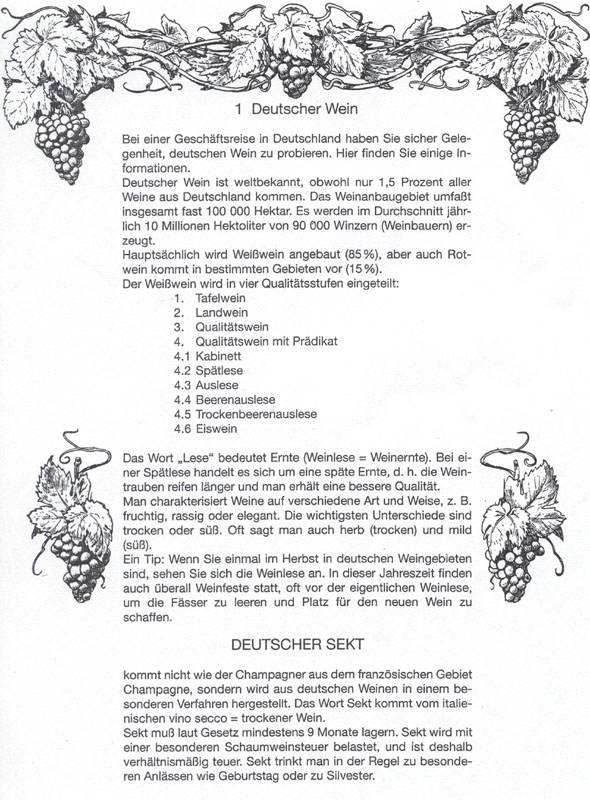
This dandy little chart is from the book ,Geschäfts-Kontakte, p.106 published by Langenscheidt 1991.
During a business trip in Germany you will certainly have the opportunity to sample German wine. Here is some information.
German wine is known world wide, although only 1.5% of all wine comes from Germany. Altogether the wine growing area comprises almost 100,000 hectares ( 247,000 acres). On the average 10 million hectoliters (264 million gallons) are produced annually by 90,000 wine-growers.
Mainly white wine is cultivated and it accounts for 85% of production, but red wine (15%) is also produced in certain regions.
White wine is divided into four grades of quality:
The word "lese" means harvest. A "spätlese" wine comes from a late harvest, which means the grapes ripen longer and a better quality is obtained.
Wine is characterized in different ways e.g., fruity, spirited, or elegant. The most important differences are dry or sweet. The words "herb" for dry and "mild" for sweet are used frequently.
A tip: If you are ever in a German wine region during the fall, check out the wine harvest. At this time of year wine festivals are held everywhere, frequently before the actual wine harvest, in order to empty the barrels and make room for the new wine.
Unlike champagne, German sekt does not come from the French region of Champagne. It is produced from German wines in a special process. The word "sekt" comes from the Italian "vino secco" which means dry wine.
According to law sekt must be lagered for at least nine months. Sekt is levied with a special sparkling wine tax, and is therefore relatively expensive. As a rule sekt is drunk on special occasions like birthdays and New Year's Eve.